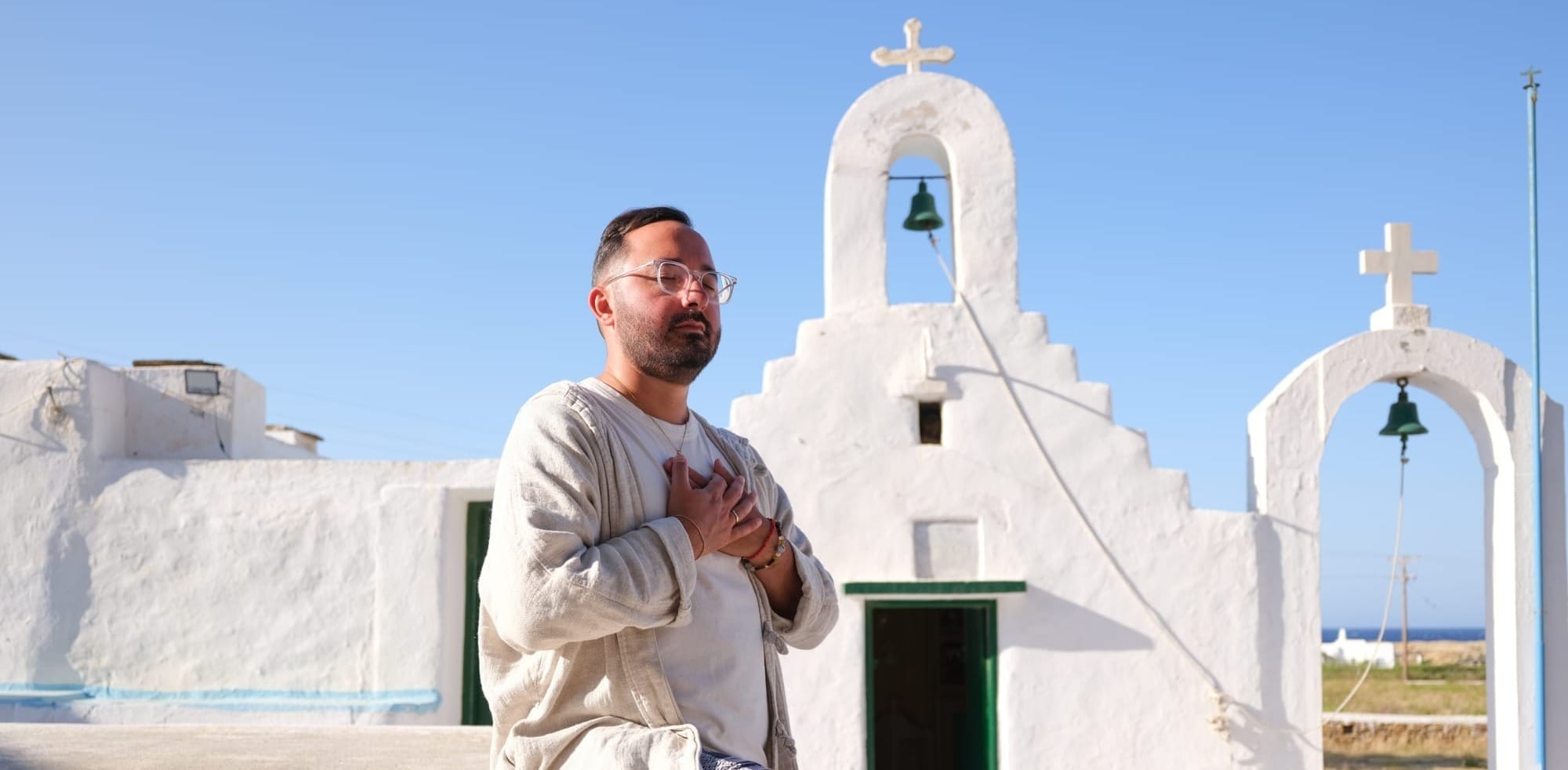
In April, I left the United States to begin a new life chapter in Greece. Since then, I’ve made my home on Crete: the island of the gods. With each passing day on this ancient land, I am encountering a new relationship with time, the pace of life, presence, and my own Being.
Life in Crete
Steeped in history, myth, familial ties, and a deep sense of community, this place supports a different way of life for me. My nervous system has finally learned that when you hear a horn honking, no one is angry. It is simply because a friend or neighbor is greeting another. (People almost never honk their car horns for any other reason).
As I spend more time here, I keep feeling like Crete is not really operating in the year 2026. What I mean by this is that while the rest of the Western world is hyper-focused on the AI race, technological advancements, and even greater velocity, life in Crete feels different. This island is operating on a different frequency altogether.
Crete feels like it is anchored in history. Not stuck. Grounded. Deeply rooted in what came before. The influences of the ancient Minoans, the Roman Empire, and the Ottoman Empire are everywhere. You can feel the past everywhere you look. It’s almost like this corner of the world is existing in the space between the ancient past and the emerging future.
The experience of time itself feels different here. Days feel…not necessarily longer, but more spacious. I feel like I can hear my own thoughts and feel my own heartbeat much easier. Here, I know my own rhythms. My body sets the speed. It’s a far cry from the pace of my life in Los Angeles.
Growing up in the United States, I am used to life in the fast lane. In the U.S. efficiency, productivity, and achievement are the gods we raise on the altars of our lives…whether we really want to or not. Life in Greece does not operate in the same way.
Σιγά σιγά
There is a commonly used phrase that codifies life in Greece: Σιγά σιγά. (sigá sigá), which literally means “slowly, slowly.” Culturally, it refers to much more than speed. It’s closer to: “Take it easy.” “Little by little.” “No need to rush.” “It’ll happen.” “Take it as it comes.”
The word σιγά (sigá) by itself means softly, quietly, slowly…gently. And when it is repeated, the phrase has its own rhythm: “Slowly, gradually, naturally, in its own time.”
When people say the phrase sigá sigá it is almost always with a feeling of recognition or with a sincerity of heart. People use it as an acknowledgement of something, rather than simply an instruction to slow down.
What are they acknowledging? Something sacred: you. Your pace. Your unfolding. Your rhythm.
When I tell people that I’m learning Greek…sigá sigá, it is always met with a smile or a nod. The subtext is almost: Of course you are. Don’t force it. Give it time.
Sigá sigá also has an interesting emotional quality to it. If you’re worried, anxious, overthinking, or trying to make everything happen immediately σιγά σιγά can mean “calm down a bit; life doesn't need to be pushed so hard.” (This is especially true when you’re navigating anything bureaucratic around here).
When most people say σιγά, σιγά, they say it in a warm, knowing way that expresses almost a shared philosophy:
There is enough time. You don’t have to conquer the whole thing today. Relax.
For someone coming from the U.S., where a faster pace implicitly means better, σιγά, σιγά can feel surprisingly profound, refreshing, and even confronting. It’s a permission slip to take life at your own pace, not at the hurried race of others.
A Philosophy and a Way of Life
It’s as if this single phrase encapsulates a philosophy that is deeply rooted in Greek culture: slow down. Connect with your own pace. Make space. There’s nothing to prove here. All things take time. Life doesn’t need to happen so fast.
In Greece, meals take time, conversations take time, and coffee can take several hours. No one will ever pressure you to leave a taverna, even if you’ve been there for most of your afternoon. Relationships develop over time. Projects unfold over time. Schedules are far more flexible than they are in America.
Why? Because in Greece, your humanity is more important than your productivity.
And that is what my time here is reminding me: I am a human.
The longer I live here, the more I wonder whether σιγά, σιγά is an invitation back into Being: back into the internal rhythm that becomes available to us when we create enough space.
Honoring the Pace of Your own Being
It generally doesn’t matter to a Greek person that something gets done fast. The low-grade urgency that hums beneath life in the United States and the constant sense of being slightly behind, is largely absent here. I understand why so many people fall in love with this place. The beauty draws them in. The way of life is what makes them stay.
For me, Crete has become a place of return. I am coming back to my Being here. What strikes me most is that the Greeks seem never to have left theirs, or at least never turned away from it as far as the rest of us have.
Permission to move at your own pace is permission to connect with your Being. When we live at a speed our bodies were never designed to sustain, something in us goes quiet. We lose our connection to the Source of life itself. We become efficient at living a life we’re no longer present for.
Leading at the Speed of Being
Nowhere is the value of speed more visible than in leadership.
Most of the founders and executives I work with are extraordinary at velocity. They can rally a team, close a round, and make a hard call before lunch. Speed is how they built what they’ve built, and for a long time it served them.
But speed also has a cost that rarely shows up on a company dashboard. When leaders move faster than their own Being, they begin to lead from momentum and not from their core essence. Decisions come from the version of themselves the pace requires...not what their soul needs. And their body starts to feel it: sleepless nights, a tightness no vacation quite resolves, a quiet sense that the work no longer feels like theirs anymore.
The culture we’ve built around leadership rewards this disconnection. It expects leaders to be committed to urgency and exhaustion. It leaves very little room for what a leader most needs in order to lead well: connection with their Being.
Sigá sigá is a reminder that some things can’t be rushed. The most important things in your leadership are among them. Trust takes time. Vision takes time. A team’s culture forms little by little. Your own clarity arrives when it arrives, usually after you’ve stopped chasing it. These things can’t be forced and they can’t be rushed.
Leading from Being means letting your Being set the pace. You’ll still need to take action, but when you do, it’ll come from a deeper sense of alignment and deep presence, not simply from programming that tells you to react quickly.
Sigá Sigá at the Threshold
Being honest about how fast our internal world, our nervous system, and our spirit wants us to move matters most when a leader stands at a threshold.
A threshold is the moment when the identity that carried you stops fitting. You're in between and old and a new. A role ends or expands. A company outgrows its founder, or the founder outgrows the company. Something that once felt like purpose starts to feel like obligation. Every instinct trained by a high-velocity life says to figure it out fast: make the next move, fill the gap.
But these are usually the moments where our Being invites us to do the opposite and slow way down.
Identity doesn’t change on a deadline. Who you are becoming unfolds sigá sigá, little by little, in its own time. When we rush a threshold, we usually rebuild our old identity in a new setting and wonder why nothing feels different. When we give it room, we get to meet who is actually emerging and lead from there.
Wherever you are today, whatever you’re building or releasing, take your time. Honor your pace. Honor your Being.
Σιγά σιγά.
An Invitation: The Threshold Salon
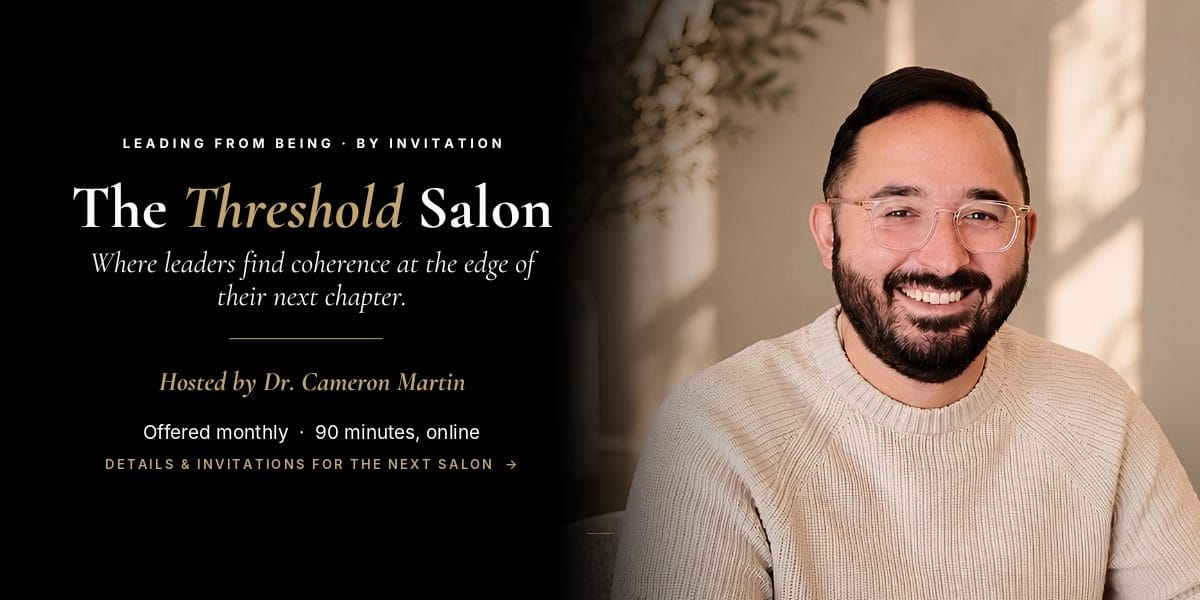
Each month I gather six to eight founders and executives in a small virtual room for a conversation about moving through moments of change and the evolution of our leadership. Together we look at where your leadership has fallen out of coherence, why this moment is asking something new of you, and what your first move toward leading from Being might be. We take our time, and no one is rushed toward an answer.
The Salon is complimentary and by invitation. If you are standing at a threshold of your own, I’d love for you to request a seat.